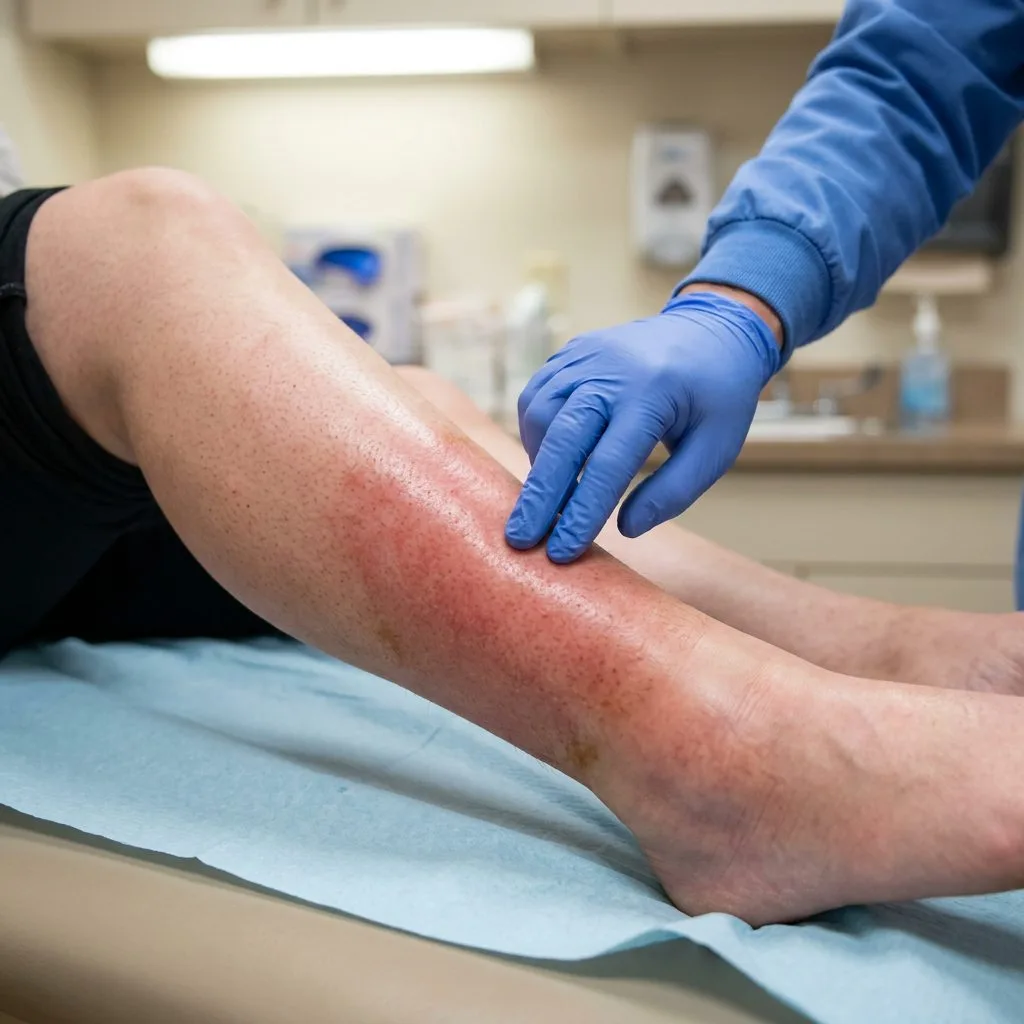
A tender red lump that is filling with pus is almost always a boil (an infected hair follicle) or a skin abscess (a deeper pocket of pus). The most useful first step is a warm, moist compress for 10–15 minutes several times a day to help it come to a head — and do not squeeze it. A licensed clinician can review a clear photo online, prescribe oral antibiotics when the area is spreading, and tell you whether the lump is large enough to need in-person drainage.
Seek emergency care if: you have a fever, the redness is spreading quickly or has a red streak running from it, the lump is on your face near the eyes or nose, or you feel generally unwell — these point to a deeper or spreading infection that needs urgent in-person care.
See a clinician nowWhat is a boil or abscess?
A boil (furuncle) is a bacterial infection that starts in a hair follicle and forms a tender, pus-filled lump. When several boils merge, that larger mass is called a carbuncle. A skin abscess is a walled-off pocket of pus deeper in the skin. Both are most often caused by Staphylococcus aureus — including MRSA in some cases.
They commonly appear where skin rubs together or where there is friction, sweat, or hair: the armpits, groin, buttocks, thighs, neck, and face. The body walls off the infection, which is why a defined, fluctuant lump forms rather than a flat red patch.
Do I have a boil? Common signs
If most of these describe what you're experiencing, an online evaluation is a reasonable next step:
What to do right now
- Apply a clean, warm, moist compress for 10–15 minutes, 3–4 times a day — this is the single most helpful home step
- Do not squeeze, pop, or cut into it — this can push the infection deeper
- Keep the area clean and covered with a loose, dry dressing
- Wash your hands before and after touching it, and don't share towels or razors
- Take an over-the-counter pain reliever such as acetaminophen or ibuprofen if needed
- Take a clear, well-lit photo so a clinician can assess size and surrounding redness
How an online clinician can help
Telehealth is well-suited to evaluating boils and small abscesses. A clinician reviews your photo and history, confirms it is a follicular infection rather than something else, and prescribes a course of oral antibiotics when the redness is spreading or you have systemic symptoms. They will also coach you on proper warm-compress technique.
Telehealth is not the right path for: a large, soft, fluctuant abscess that clearly needs to be lanced and drained (a quick in-office procedure), abscesses on the face near the eyes or nose, any boil with fever or rapidly spreading redness, or recurrent boils in someone with diabetes or a suppressed immune system — these are referred for hands-on care.
A small boil often resolves with warm compresses alone — but a pocket of pus that has formed usually needs drainage, not just a pill.
How boils are treated
For early, small boils, warm compresses to encourage spontaneous drainage are often enough. When there is surrounding cellulitis, fever, or multiple lesions, a clinician may prescribe oral antibiotics that cover staph — commonly trimethoprim-sulfamethoxazole, doxycycline, or clindamycin depending on local MRSA patterns. A true fluctuant abscess is treated with incision and drainage, which is done in person and provides the fastest relief.
How long does it last?
A small boil usually comes to a head, drains, and heals over 1–2 weeks with warm compresses. An abscess that is drained typically improves within a day or two of the procedure. If a lump is getting larger, more painful, or you develop a fever, it needs prompt re-evaluation.
Frequently asked questions
Will antibiotics alone cure a boil or abscess?
Small early boils may settle with warm compresses, but a true abscess that has formed a pocket of pus usually needs to be drained — antibiotics alone often won't clear it. A clinician decides whether antibiotics, in-person drainage, or both are needed.
Can I pop or squeeze a boil at home?
No — squeezing can push bacteria deeper and spread the infection. Use warm compresses several times a day and let it drain on its own, or have it drained by a clinician. Never cut into a boil yourself.
Can a boil be treated online?
Yes for evaluation. A clinician can review photos, advise on warm-compress care, prescribe oral antibiotics when appropriate, and tell you whether the lump needs in-person drainage. Large or facial abscesses are referred for hands-on care.
Why do I keep getting boils?
Recurrent boils can be linked to staph (including MRSA) carriage, friction, diabetes, or hidradenitis suppurativa. Two or more episodes warrants evaluation, and sometimes decolonization or a longer treatment plan.
Is a boil contagious?
The bacteria can spread to others through skin contact or shared towels and razors. Keep the area covered, wash hands often, and don't share personal items until it has healed.